Oryori Eigetsu, Hongo: A Night of Ingredients at Their Best
In a converted machiya one street back from the main road — Furano Wagyu from Hokkaido, fresh fish from Karatsu, Tadao Gold pineapple from Okinawa. Eight counter seats, reservation only.
Eisuke Kameta
March 13, 2026
Solo Score
★★★★★
Budget
¥27,500 course (drinks extra)
Access
10 min walk from Toei Oedo Line Hongo-sanchome Exit 2
Leaving Hongo-sanchome station, I turned away from the main road and entered a narrow lane. Old houses on both sides. Further in, a machiya with a noren curtain hanging outside. The signage is small. On a first visit you might walk past. That slight difficulty — and the relief when you find it — is part of what the evening becomes.
Oryori Eigetsu — pronounced “eigetsu.” The name refers to the waxing moon: the journey from new moon to full, the process of becoming complete.
The philosophy of the kitchen is clear. Draw out the best of carefully chosen ingredients. Nothing added that isn’t necessary. The result is that the quality of sourcing, the precision of the stock, and the accuracy of the heat are all plainly visible in each dish.
From Nishi-Azabu to Hongo
The restaurant has a predecessor. It was called Ryoriya Tokisai, in Nishi-Azabu, Minato-ku.
It opened quietly in 2015 in the basement of the Obana Building at 4-11-4 Nishi-Azabu — a counter and a private room, building a small, steady reputation. Then the building developed a serious water leak. A move became unavoidable.
The new home was a machiya in Hongo, on the eastern edge of the city. The restaurant reopened as Oryori Eigetsu: eight counter seats only, no tables, a new name, some new vessels, and everything that had made Tokisai good brought forward intact.
Eight Seats, Counter Only
The room is the counter. No tables, no private rooms. Everyone — a single guest, a couple — sits at the same counter. This structure is, for a solo visitor, the best possible arrangement.
The chef works in a kitchen behind the counter, out of direct view. The proprietress — the okami — stands at the front. She explains each dish as it arrives: the ingredients, the vessel, the thinking. Her explanations are precise, warm, and genuinely informative. For a guest eating alone, this running account is part of what makes the evening coherent.
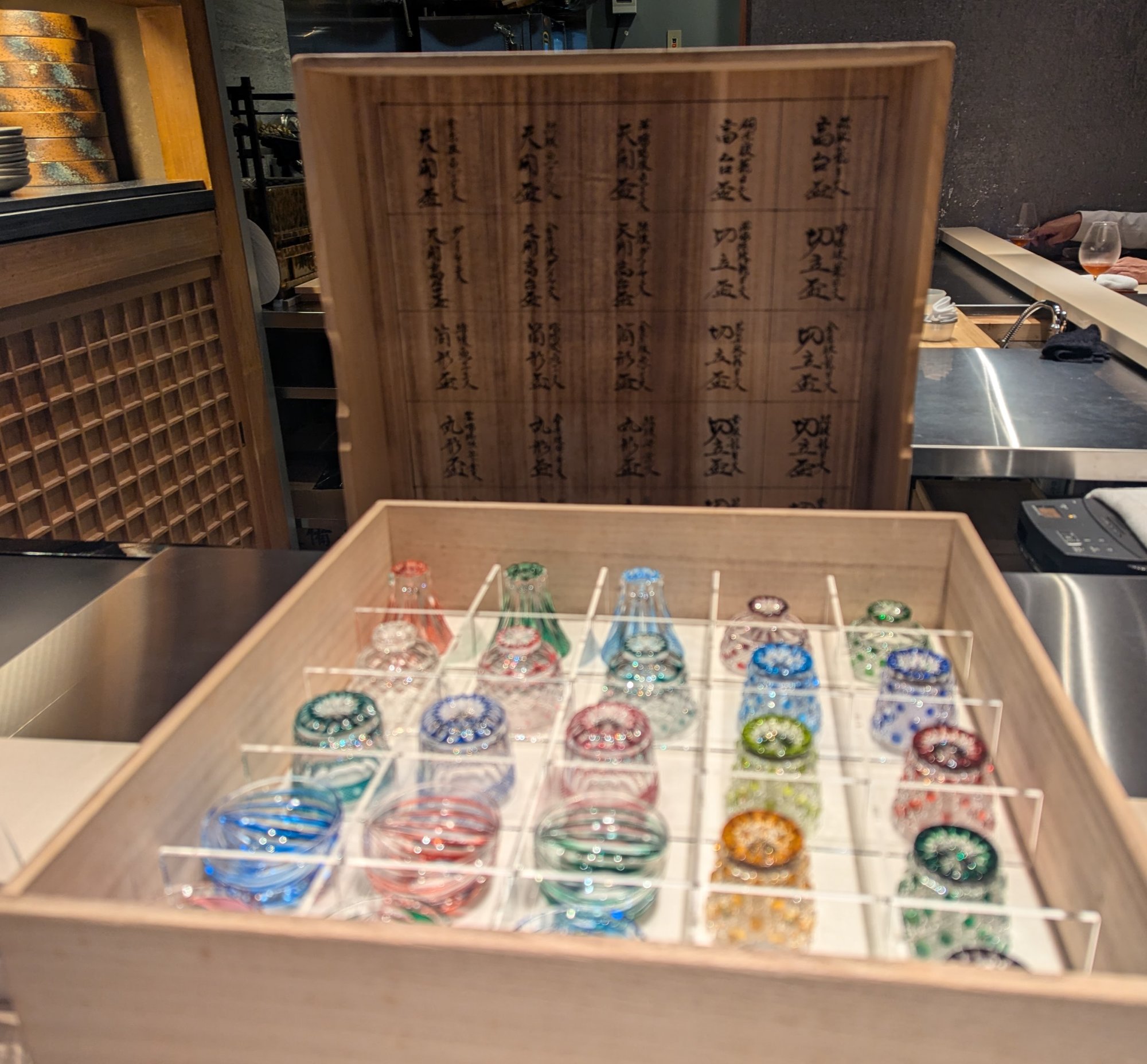
The evening begins with the Horiguchi kiriko selection. A wooden box is opened to reveal a set of cut-glass sake cups in various colors and patterns. The inside of the lid is inscribed with brushwork notes on each piece. The okami explains the motifs. You choose the one that appeals.
The Course
This was the ¥27,500 course. The sequence:
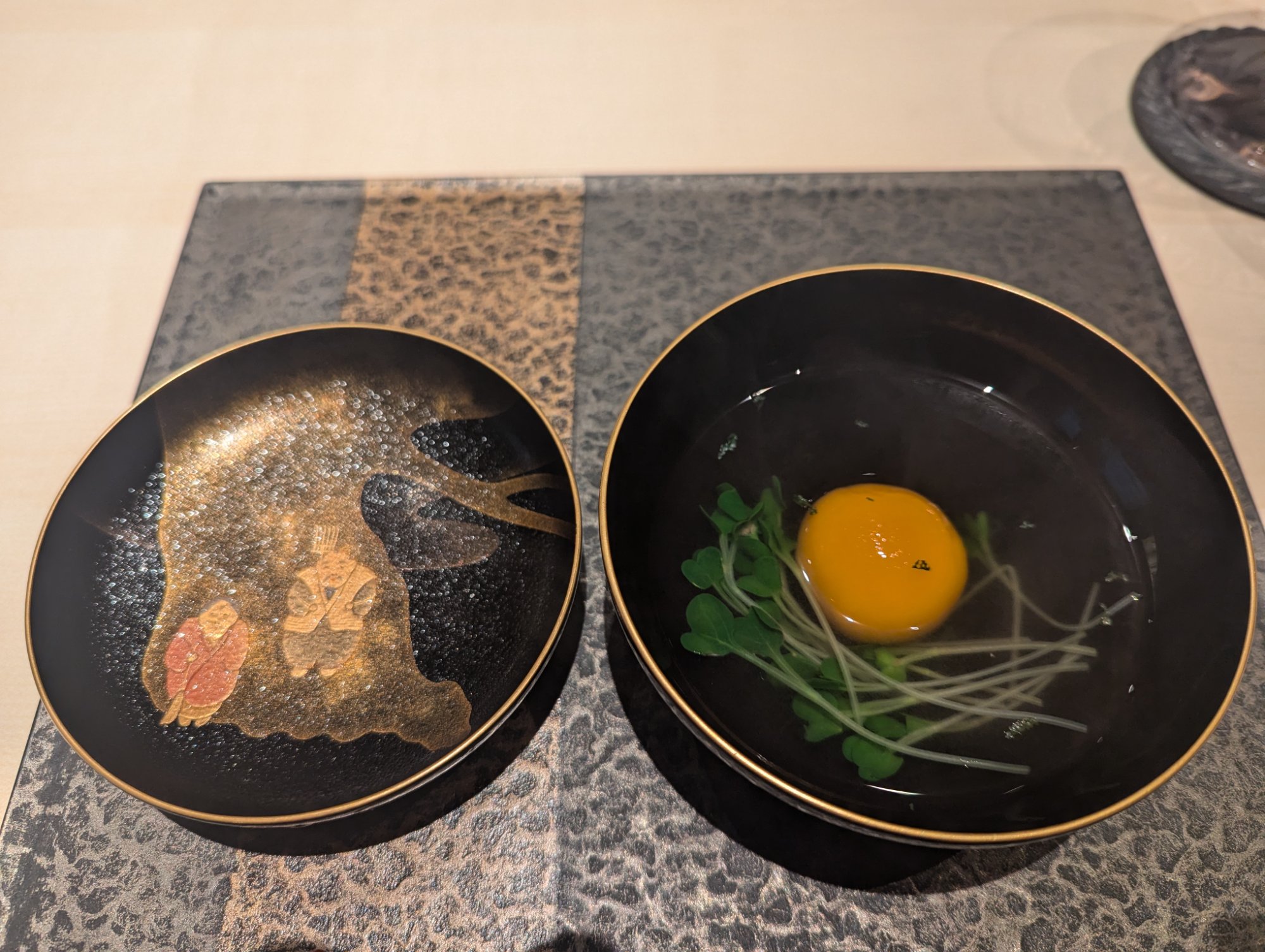
Sakizuke (appetizer) — Red taro stem and squid in tosa-zu dressing. The evening opened with a deep egg yolk and fresh shoots against a black lacquerware vessel.
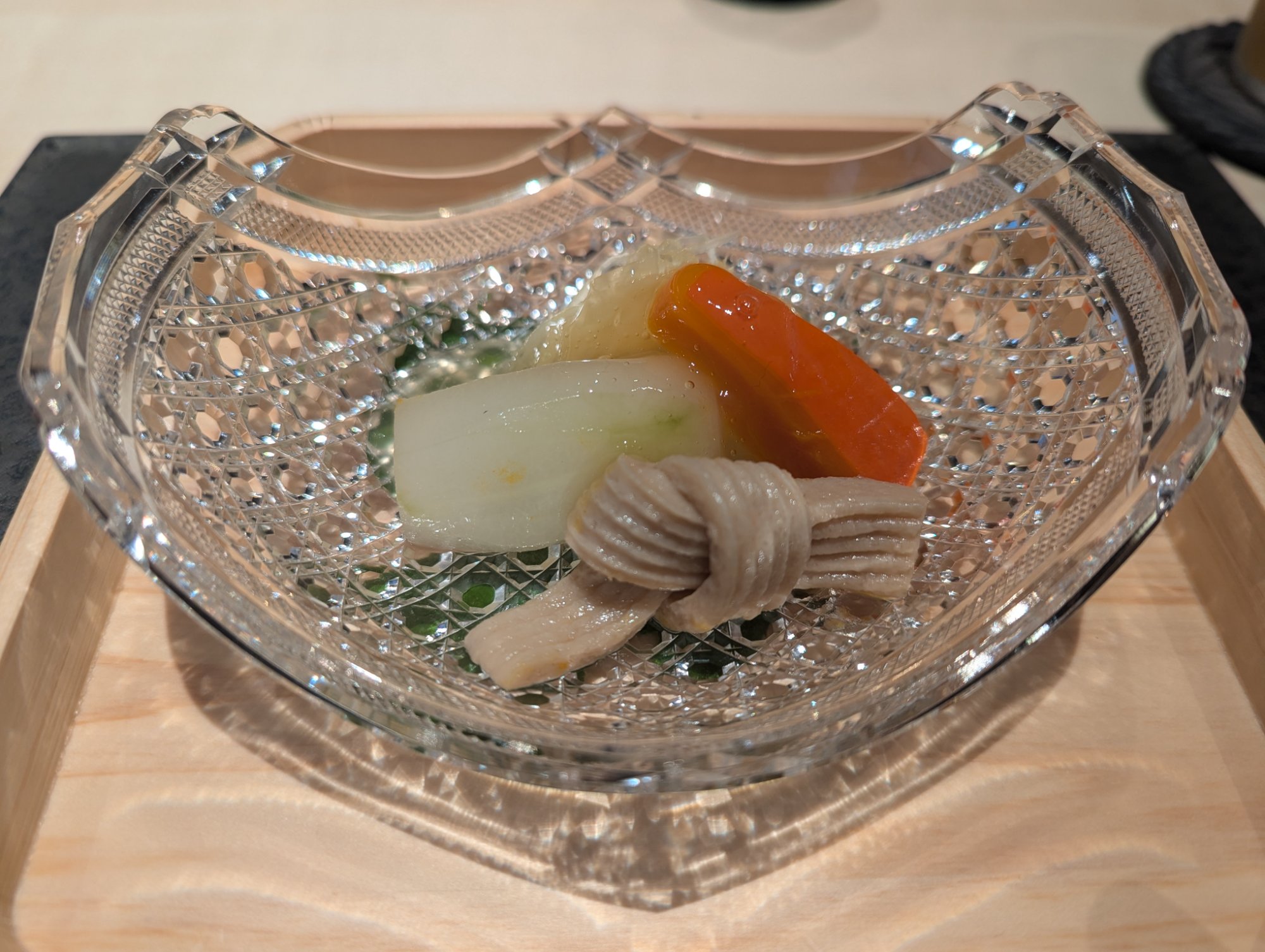
Vegetables — Chilled Kaga vegetables. Summer vegetables from Kanazawa arranged to show their cut surfaces. The vessel was a large crystal bowl with cut-glass patterning — the colors of the vegetables caught the light through the glass.
Owan (soup) — Clear soup with red nankinkabotcha squash. The sweetness of the red pumpkin dissolved slowly into a transparent dashi. When I lifted the bowl, a quiet fragrance rose.
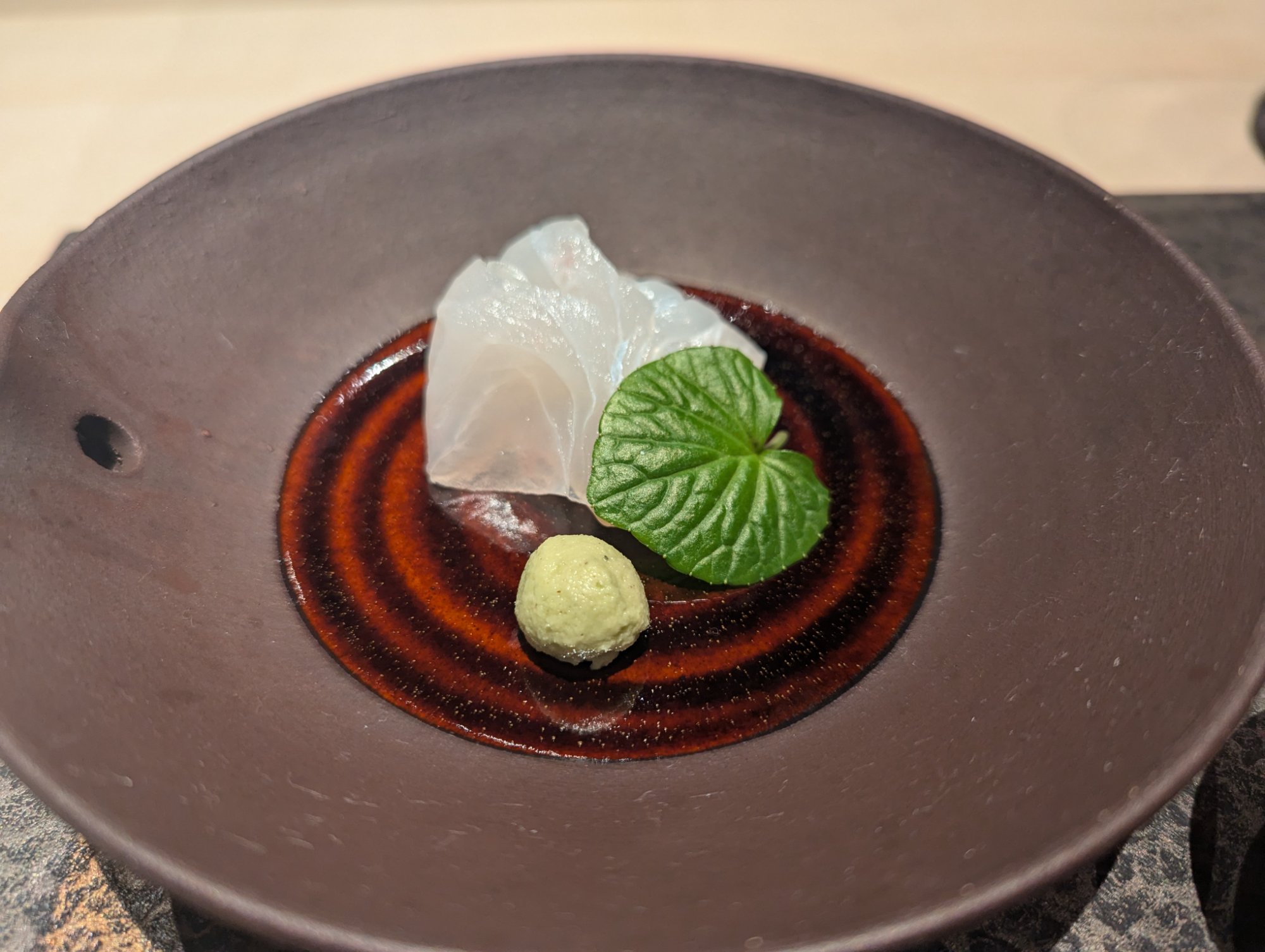
Tsukuri (sashimi) — Meitai (bigeye) from Karatsu, Saga. On a deep black Densaku-gama vessel, thin-cut fish caught the light semi-transparently. Wasabi, perilla, a red garnish. The blackness of the vessel made the white of the fish sharper.
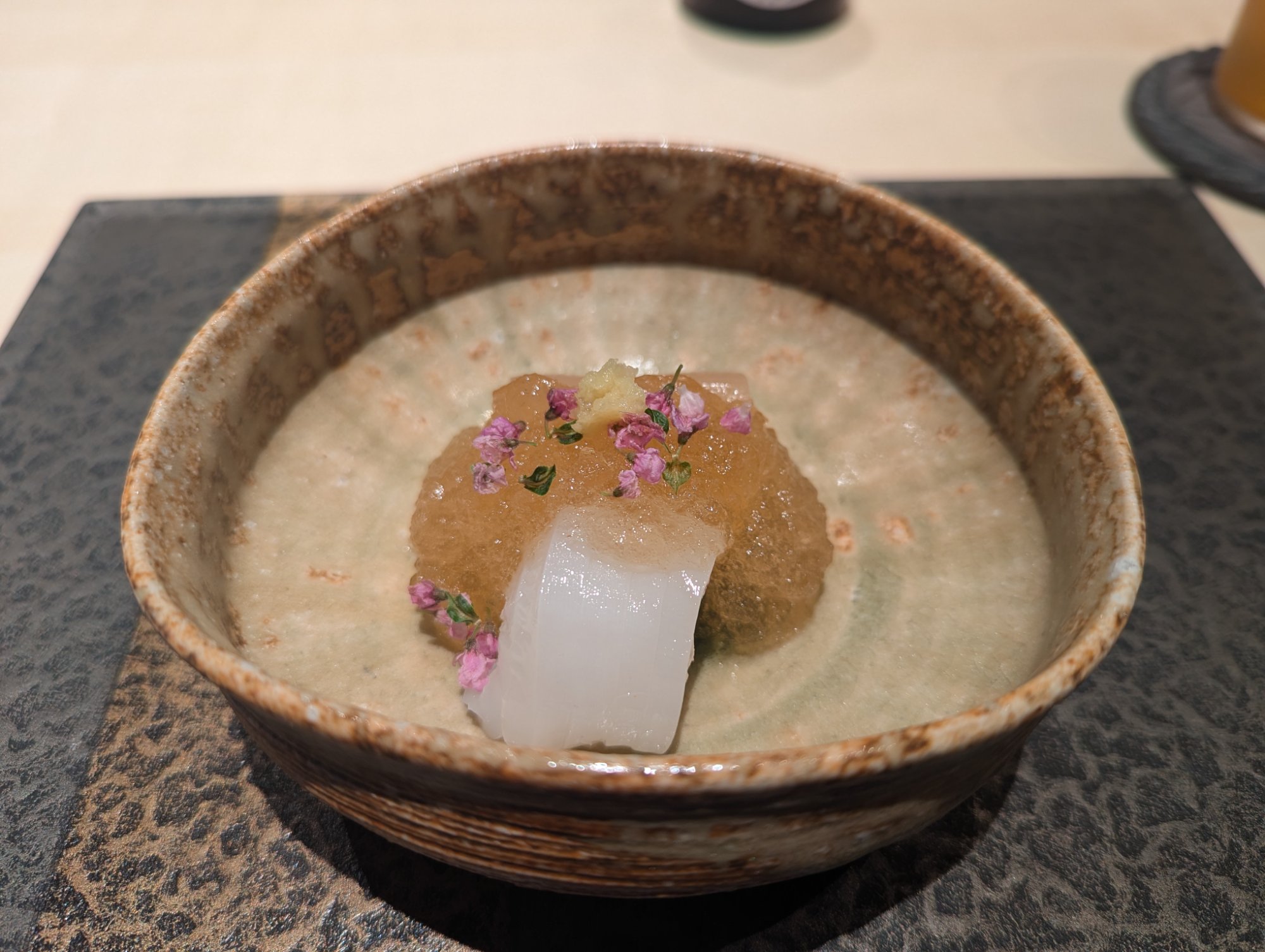
Kuchi-gaeshi (palate cleanser) — Satsuma plum (sordam) shiraae with edamame. The sourness and sweetness of the plum received by the softness of tofu. On a warm earth-toned Densaku-gama vessel, a scatter of small pink flowers.
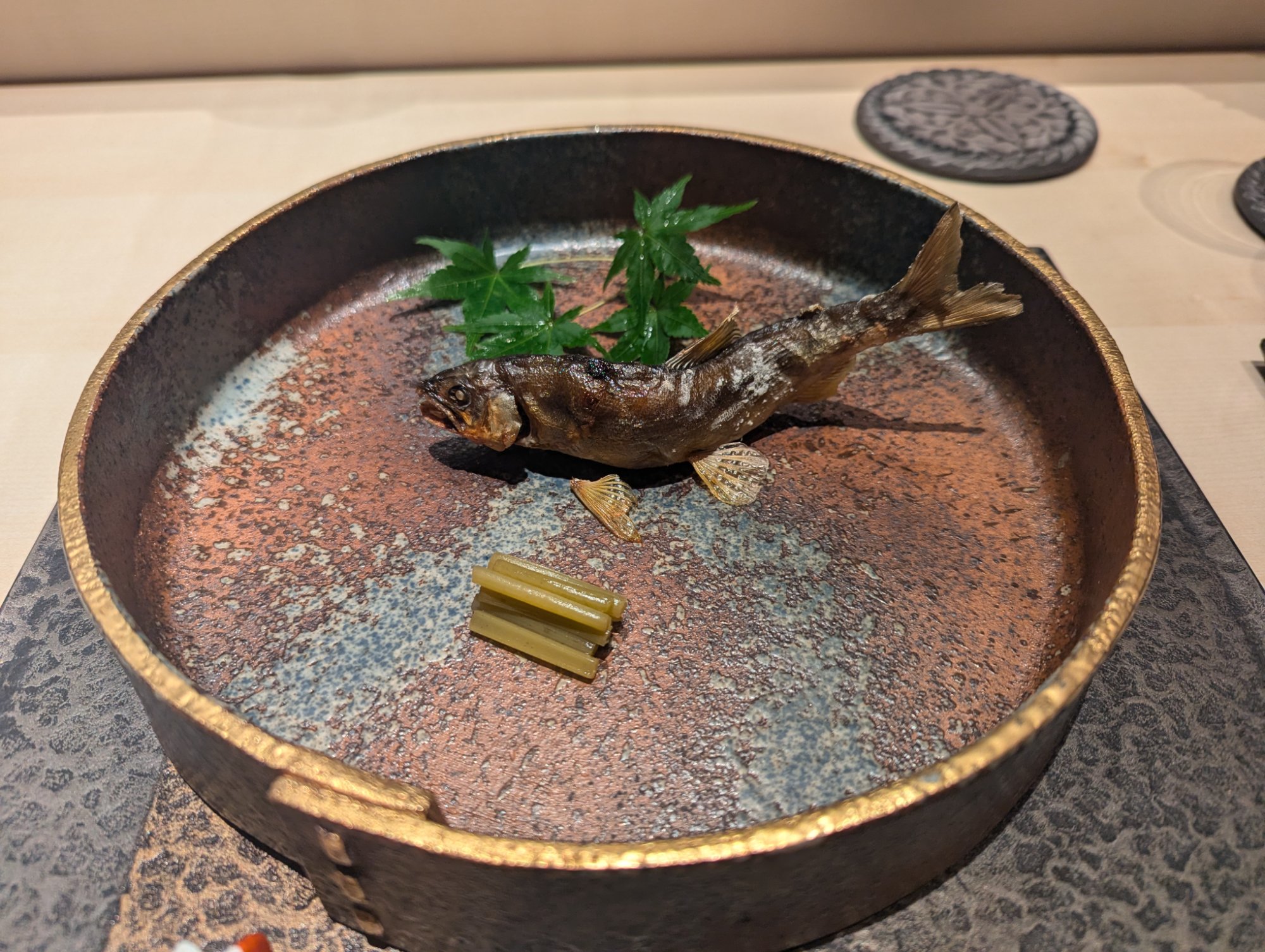
Yakimono (grilled) — Salt-grilled sweetfish (ayu), with pickled wasabi stems. A whole fish laid across a heavy iron-glaze vessel with a gold rim. The char and the river-fish character of the ayu. The acidity of the pickled stem reset the palate.
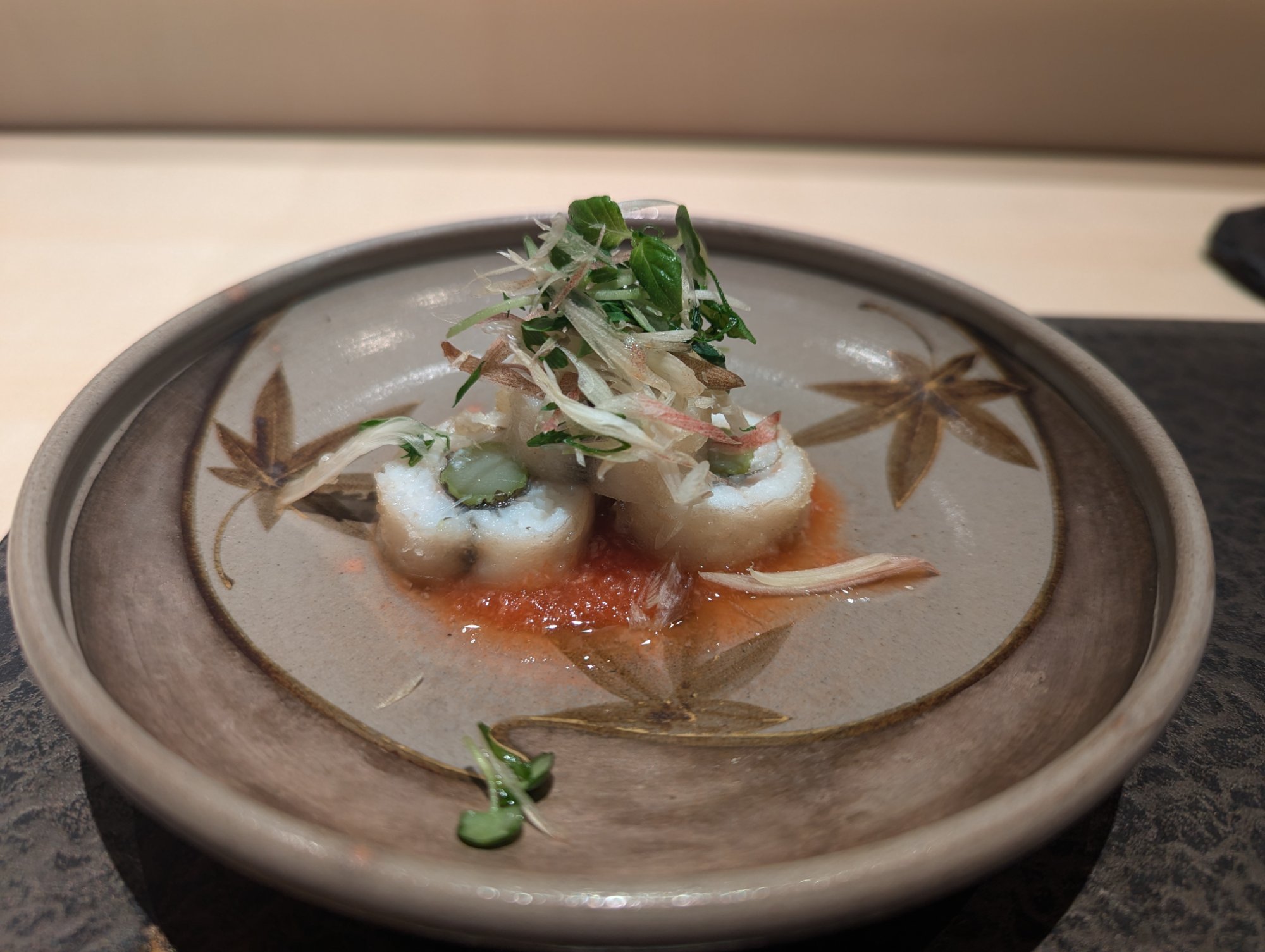
Agemono (fried) — Hamo (pike conger) with cocktail sauce. Fried hamo on a vessel with a maple-leaf pattern, paired with cocktail sauce — a dish that moved naturally beyond the conventional boundaries of Japanese cuisine while staying entirely composed.
The Center of the Evening — Furano Wagyu and Hanasansho Hotpot
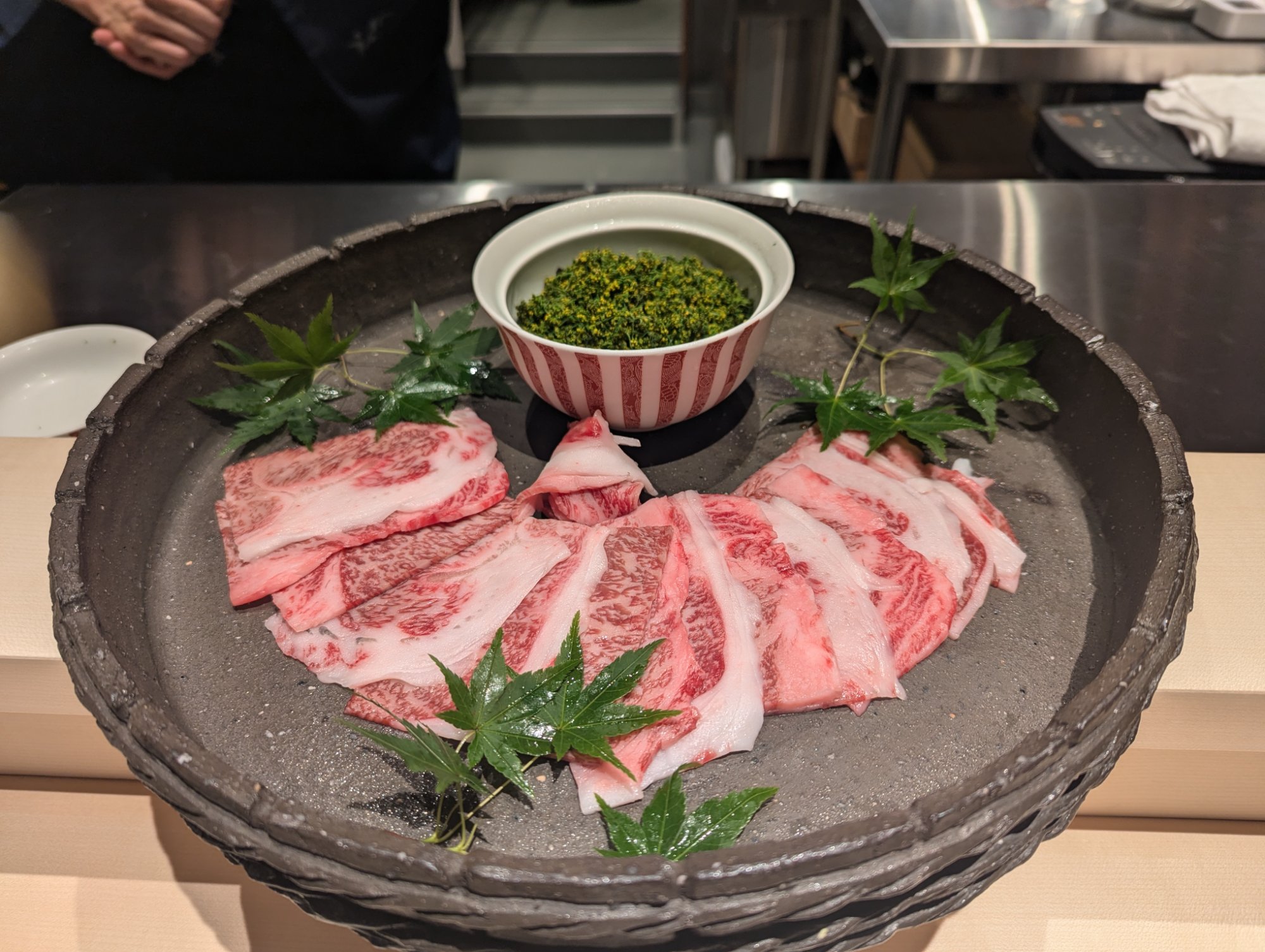
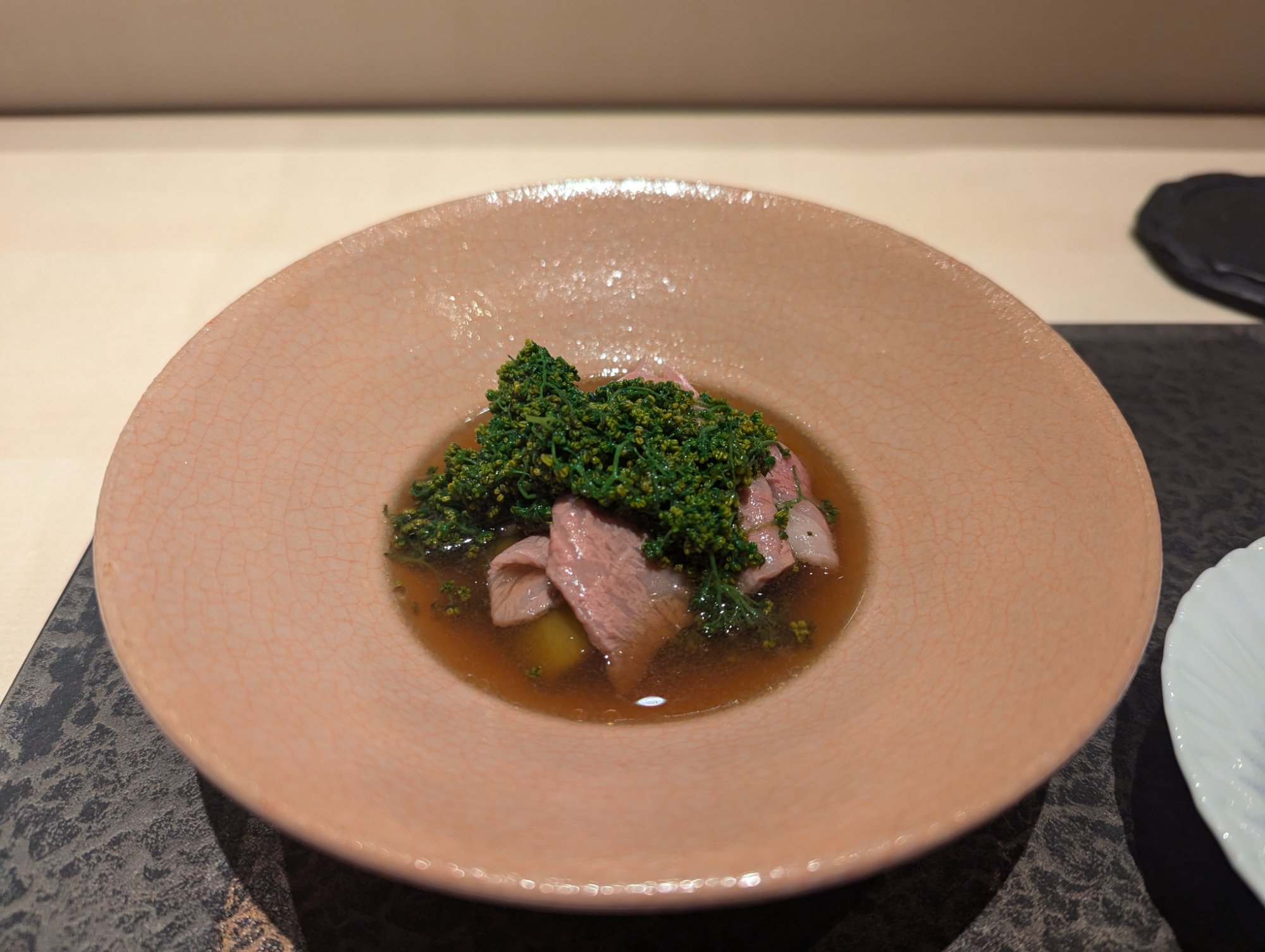
The centerpiece of the course was Furano Wagyu from Taniguchi Farm, cooked as a hotpot with hanasansho (flower pepper), accompanied by Sadohara eggplant from Miyazaki.
Before the meat goes into the pot, it is presented raw on a stone plate. The okami describes Taniguchi Farm — in Kamifurano, Sorachi district, Hokkaido — as she shows the cut. One farm, one producer, a specific breed: the marbling, the white of the fat, the red of the muscle.
Taniguchi Farm’s Furano Wagyu is produced by a single operation. A proprietary feed blend results in a fat with a low melting point. The farm has placed multiple times at the national wagyu competition.
The meat in the pot takes on the fragrance of the hanasansho as the heat enters slowly. Sadohara eggplant — a traditional Miyazaki variety, soft and high in moisture — arrived alongside. Meat, vegetable, and dashi came together in a pale pink vessel. Something completed itself in the mouth.
The Vessels — Horiguchi Kiriko and Densaku-gama
The vessels spoke as clearly as the food that evening.
The Horiguchi kiriko cup chosen at the start of the evening — I chose the cobalt blue horizontal stripe pattern. Placed on a black wooden tray, the light through the glass shifted as the tray moved.
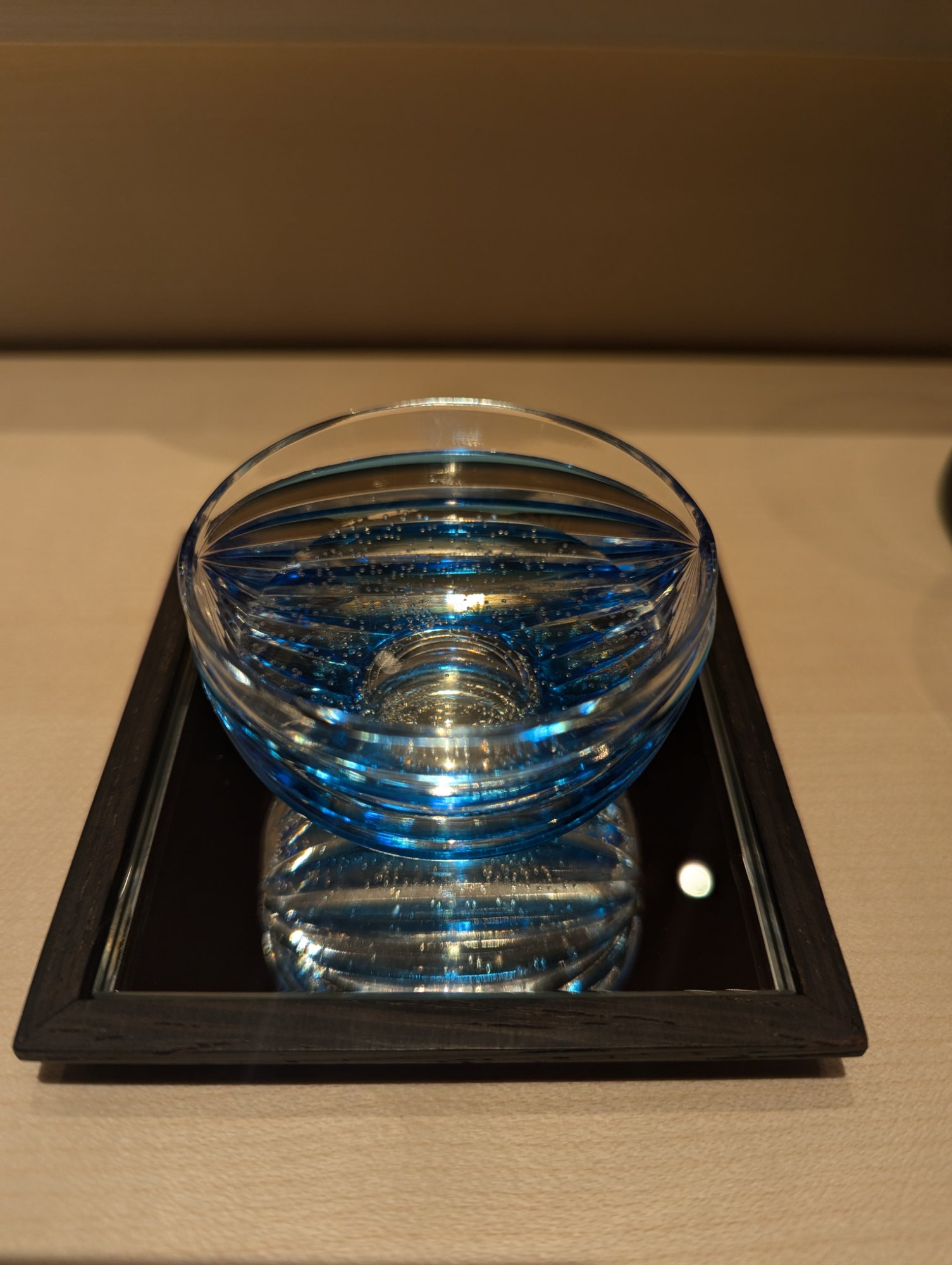
Horiguchi Kiriko is based in Sumida, Tokyo, and focuses on hand-polished glass. Pouring sake into the cup deepened the color of the liquid.
A cup painted with Mount Fuji also appeared during the evening — blue sky and white snow spread across the inside of a small vessel; a Japanese landscape compressed into a cup.
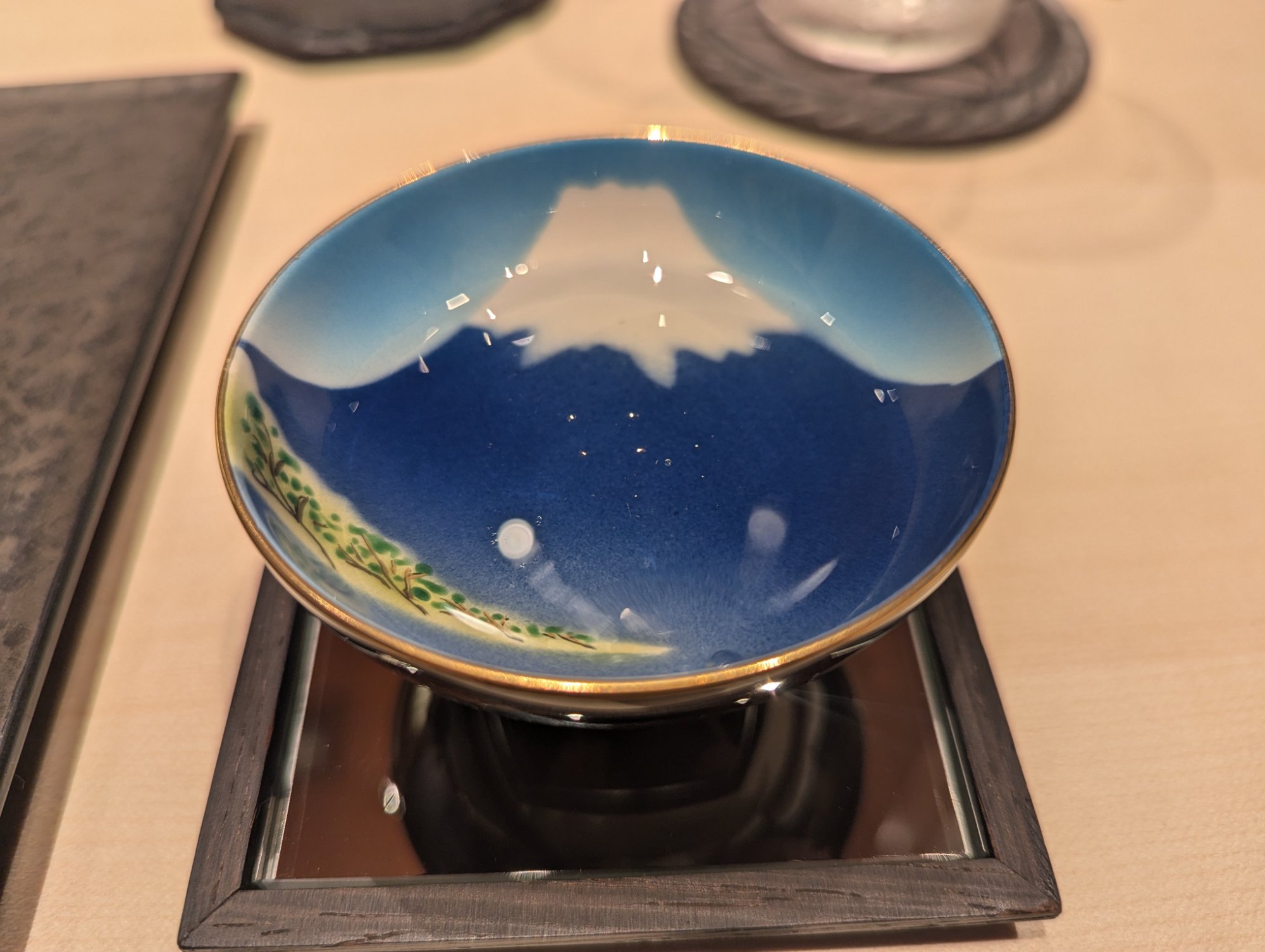
The cooking vessels were primarily from Densaku-gama: the weight of iron glaze, the warmth of earth tones. Each dish came in a different vessel, and the okami spoke briefly about each one.
The Drinks — Hitachino Nest and Ubusuna
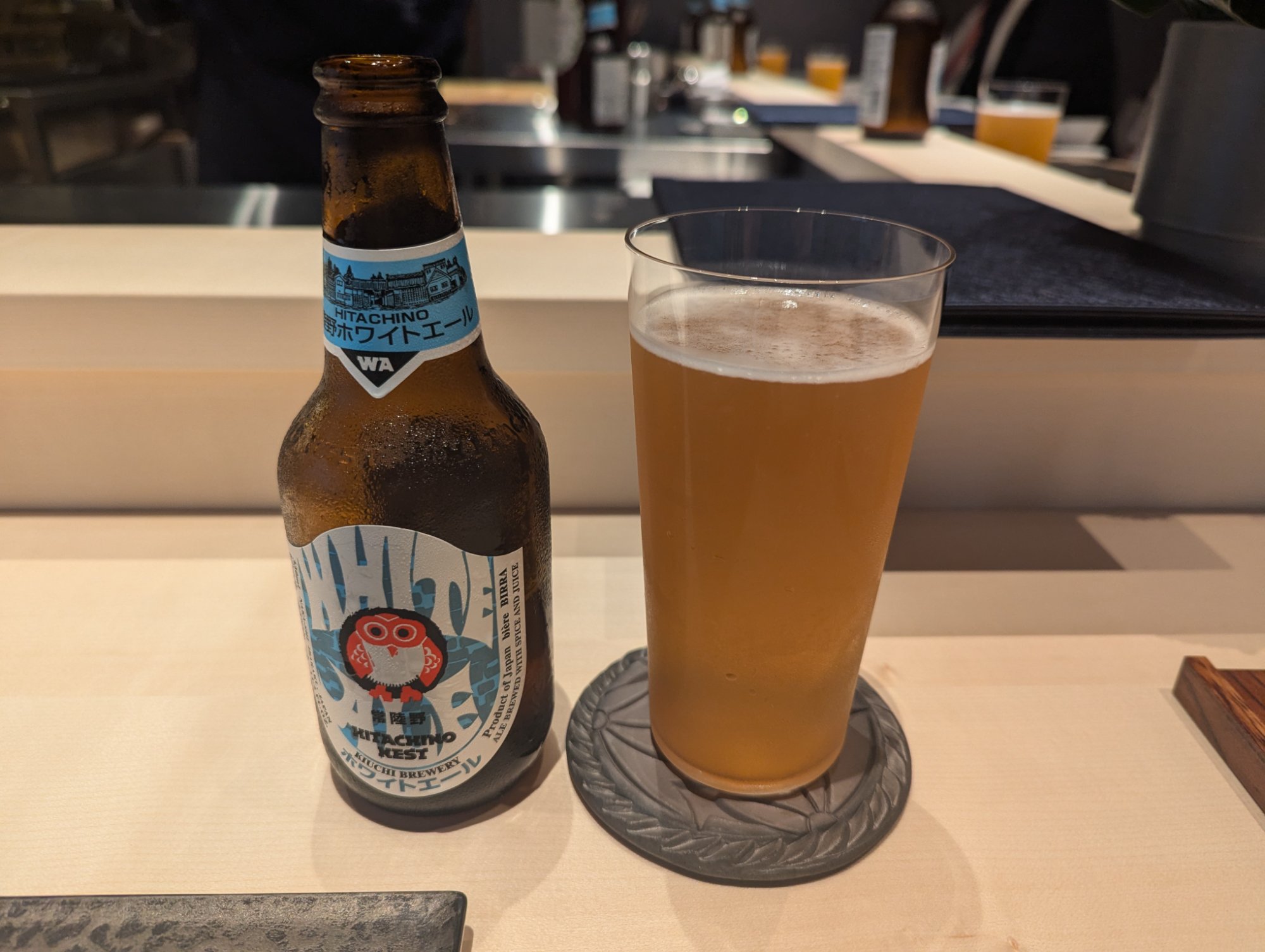
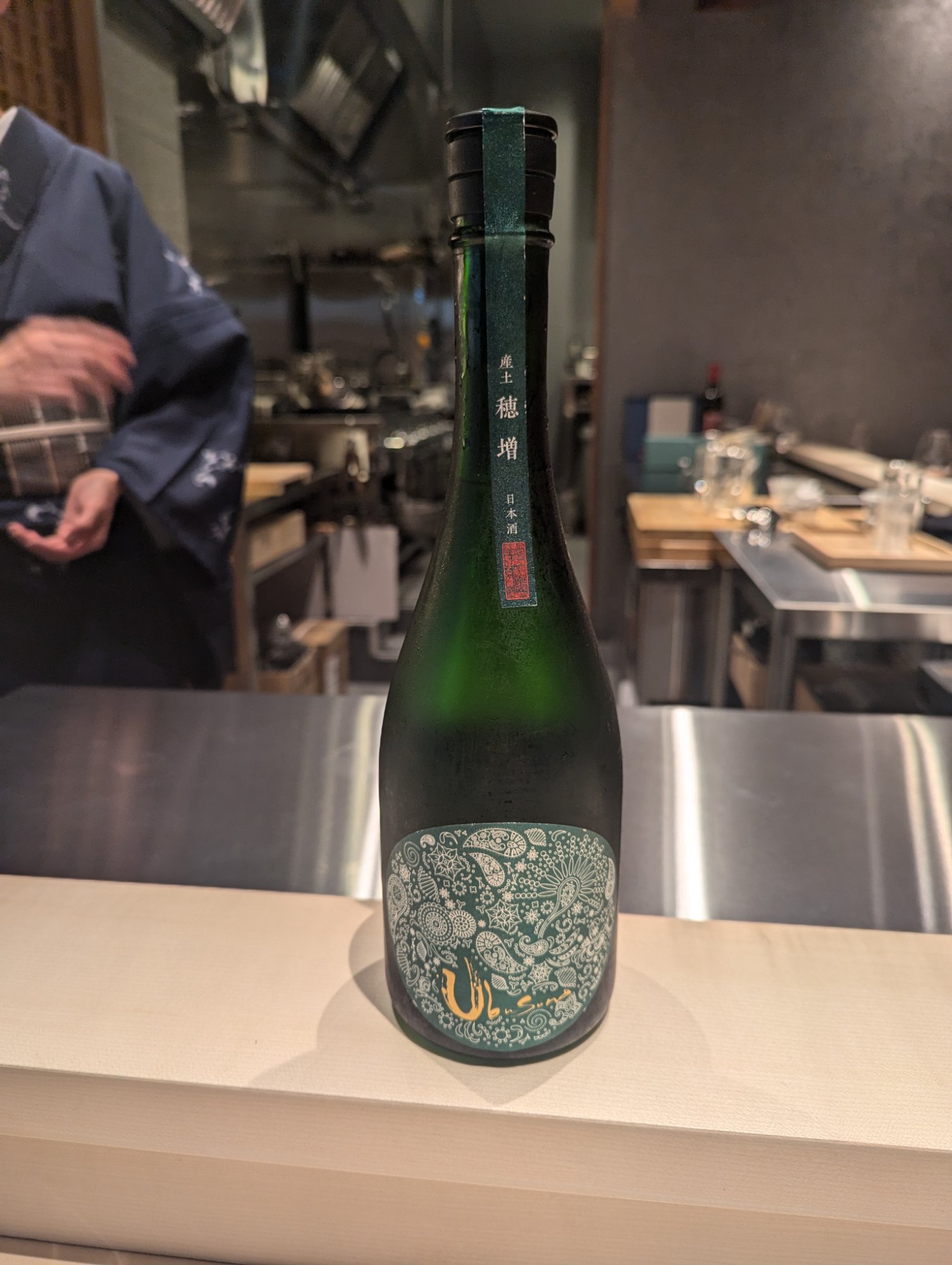
I chose Hitachino Nest White Ale and the sake Ubusuna (Homase label).
Hitachino Nest is a craft beer from Kiuchi Brewery in Naka, Ibaraki. The White Ale — recognizable by its owl label — uses orange peel and coriander. Fresh and citric. I drank it before the ayu.
Ubusuna is a natural sake from Hana no Ka Brewery in Kumamoto, made from Gohyakumangoku rice grown in Nechi Valley. The Homase label: a deep green bottle with a paisley-patterned label. Made with naturally farmed rice using traditional methods. The right speed for drinking through a long meal.
The Close — White Rice and Tadao Gold
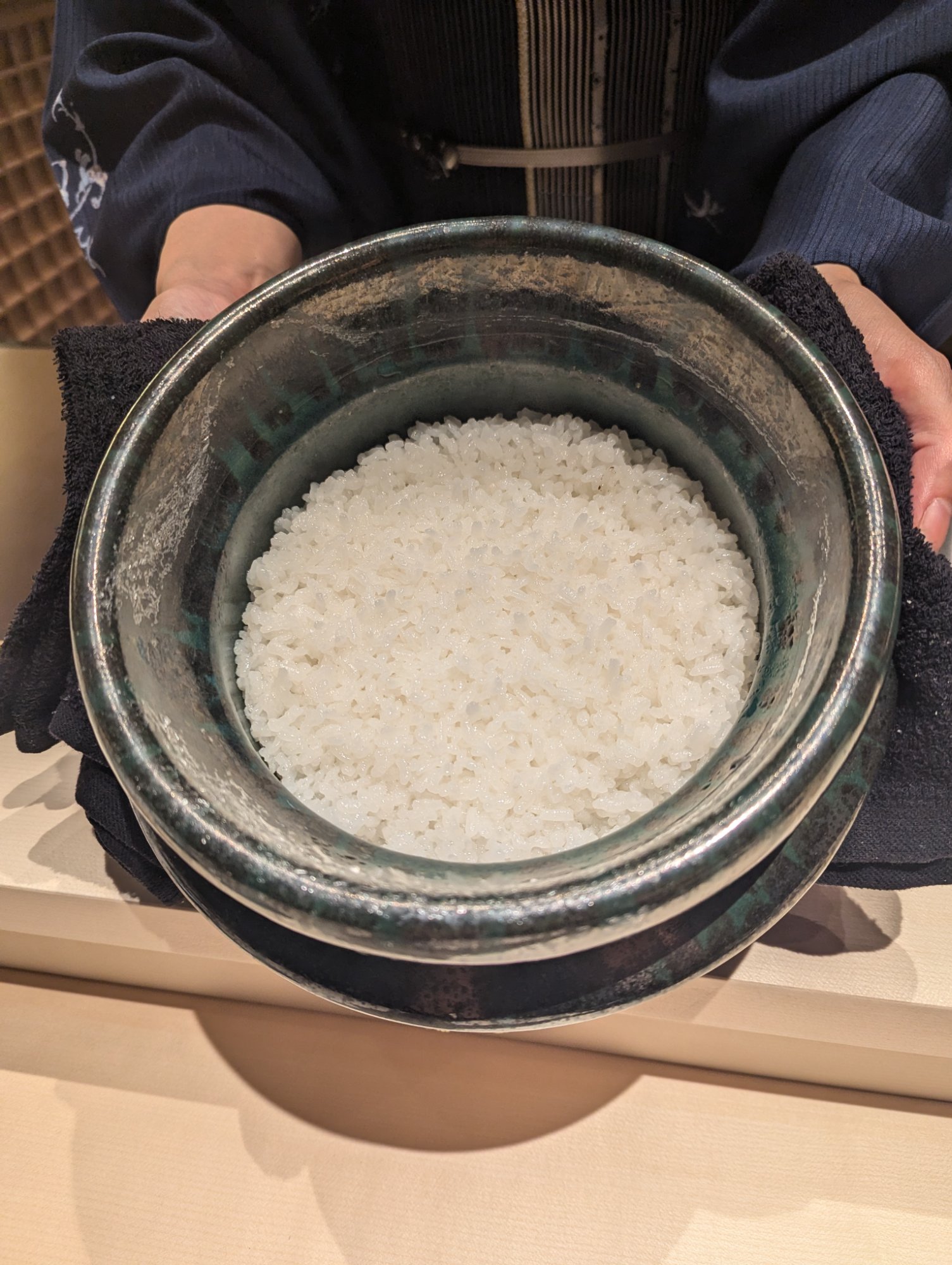
The meal ended with white rice. The okami carried the iron pot with both hands. At this restaurant they refer to it as “Hakumai-sama” — an honorific form, Rice Itself.
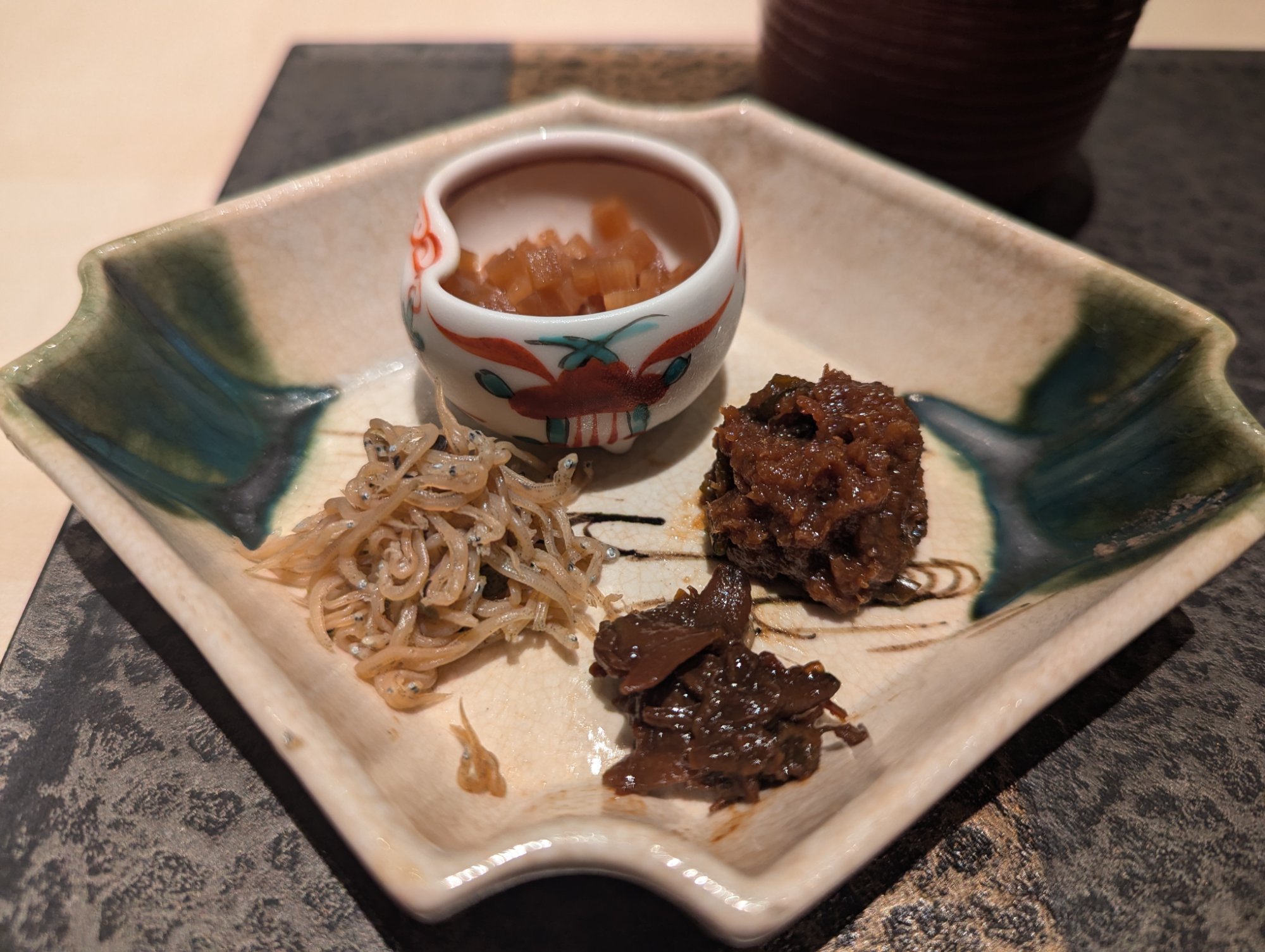
The accompaniments arrived: whitebait, kombu tsukudani, citrus pickles. Small vessels arranged in order. Trying each in turn against the plain rice.
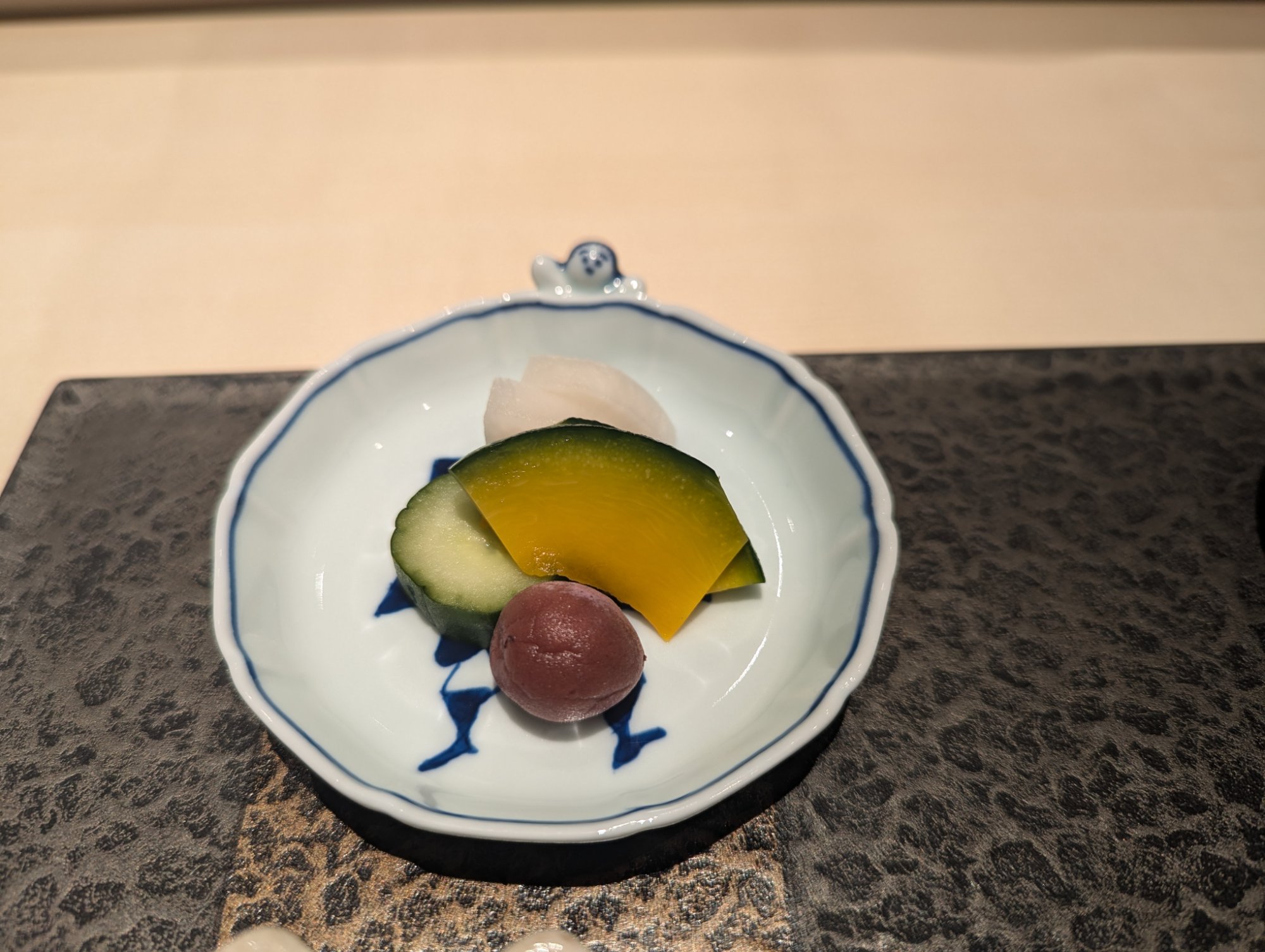
Pickles alongside — summer vegetables arranged on a blue-painted dish.
The dessert was Tadao Gold.
Tadao Gold is a Gold Barrel variety pineapple grown by Tadao Tamaki in Higashi village, Kunigami district, Okinawa. Average sugar content exceeds 18 degrees. The producer is effectively a single person. The fruit arrived on an Imari-style plate, thin slices standing like sails.
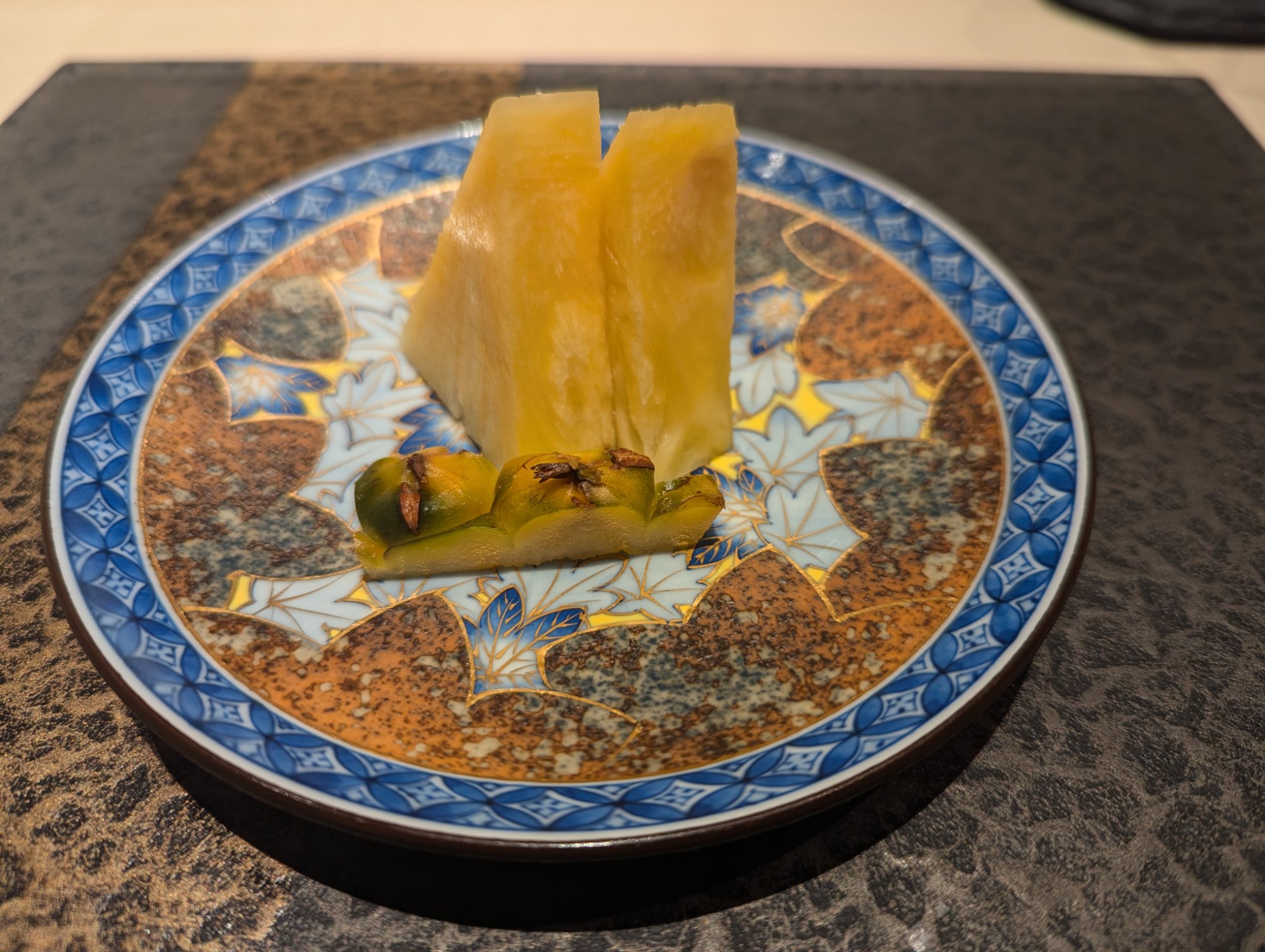
The yellow of the flesh was vivid. The cut surfaces caught the light. Almost no acidity — the sweetness dissolved softly. Ending a meal of this kind with this fruit was a considered decision.
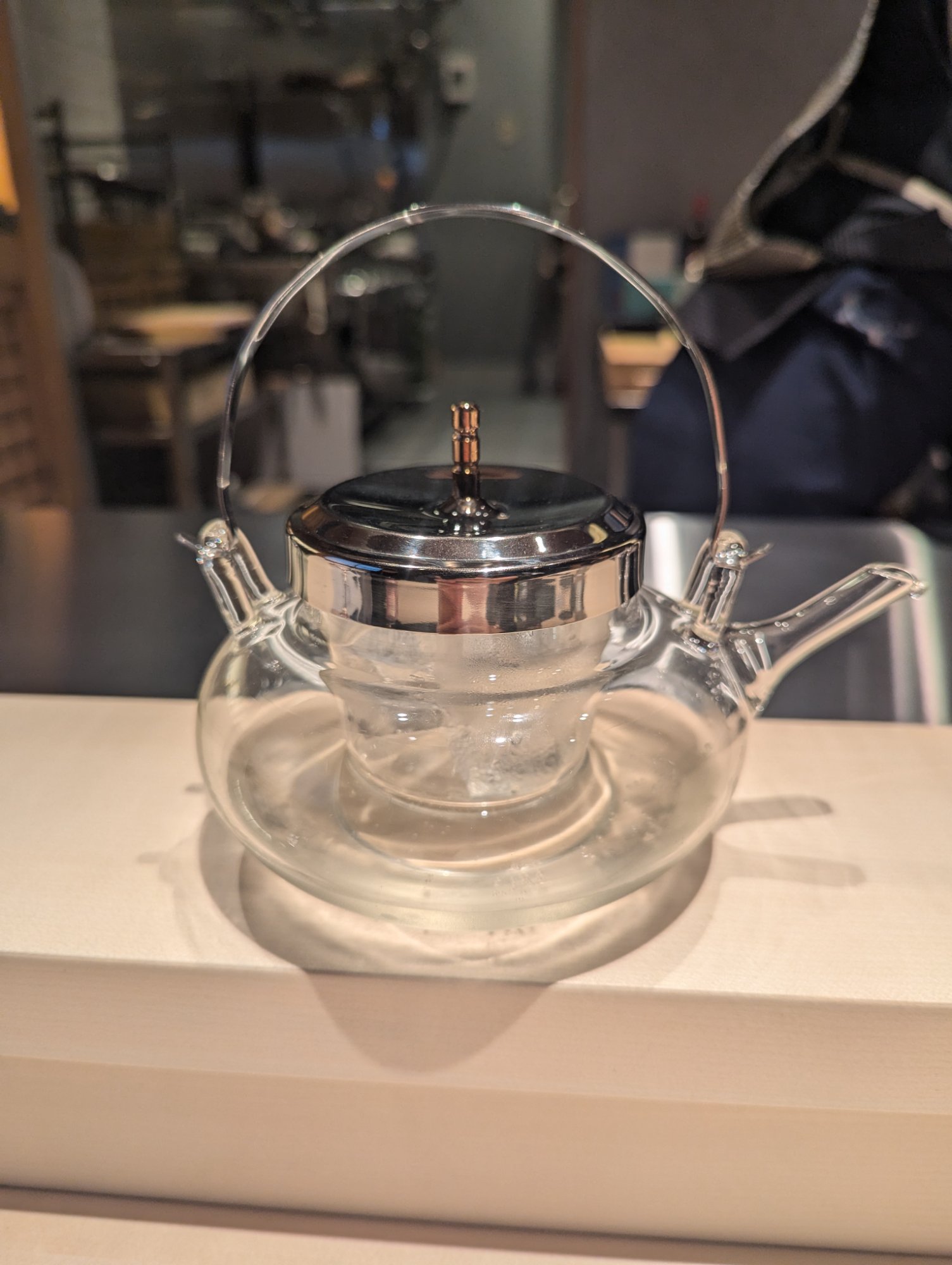
The evening closed with domestic Japanese black tea, brewed in a glass teapot. Watching the leaves open. The quiet final minutes.
For the Solo Visitor
If you are going to spend one evening alone at a counter in Tokyo, Eigetsu deserves serious consideration.
The counter-only structure, the okami’s careful explanations, the sourcing from producers across Japan, the eye for vessels, the depth of the sake and beer list — the things a solo visitor needs are almost all here. The ¥27,500 course is not inexpensive. The density of the evening justifies it.
Eigetsu: the waxing moon. A restaurant that gives you the sense of something filling, slowly, with each visit.
Oryori Eigetsu
- Address: 〒113-0033 3-8-5 Hongo, Bunkyo-ku, Tokyo
- Access: 10 min walk from Toei Oedo Line Hongo-sanchome Exit 2
- Hours: 17:00–22:30 (last entry 20:00, reservation only)
- Closed: Irregular
- Reservations: Official website
- Tel: 090-5517-0141